



Rilla alternatives in Europe: the eight questions that actually separate these tools
Every product in this category records a sales conversation and scores it, so the feature pages all read the same. Eight questions separate them, all of them answerable before you take a call. Here they are, with what each vendor publishes, checked on 27 August 2026.
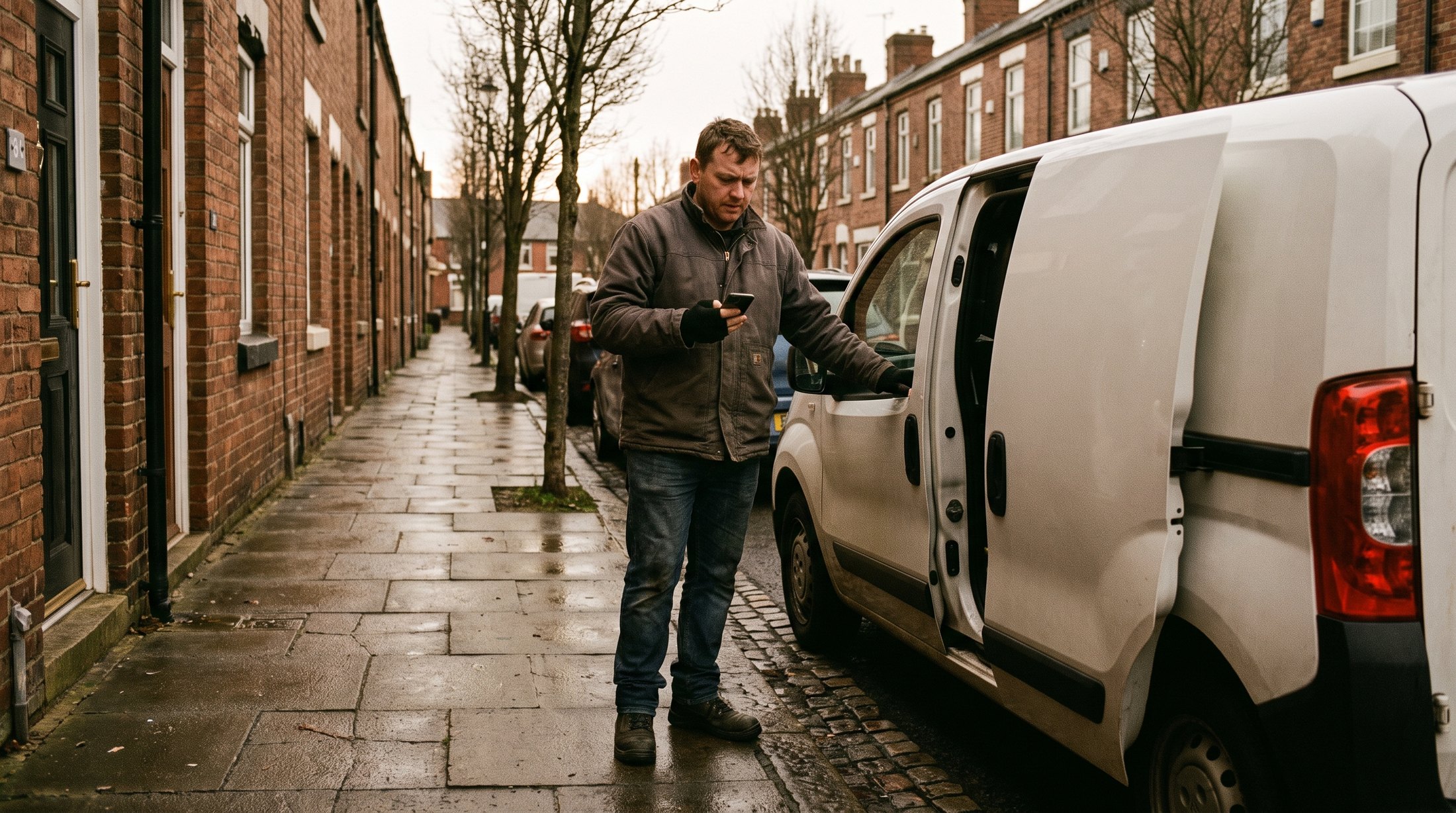
Rilla is the American reference for recording in-person sales meetings and coaching from them. Sacra puts its revenue at roughly 51 million dollars for 2025. Around it sit two other groups. One was built for remote meetings and has moved toward the field: Modjo in France, bliro in Germany, Kickscale in Austria. The other was built for the field from the start: Siro and Leadbeam in the United States, COACH in France, MIHOS in Switzerland.
Comparing them on features produces a tie. Comparing them on the eight questions below does not, and every one of them can be answered from public information or in a single email to the vendor.
1. Does it record the room, or the call?
This is the first filter and it settles half of most shortlists. A tool built for video calls receives a clean single-channel stream from a headset, with speaker labels already supplied by the meeting platform. A meeting in a customer's kitchen is 60 to 120 minutes long, has two to four voices, a dishwasher, a dog and a phone that spends part of the appointment in a jacket pocket. Diarisation, battery behaviour, offline capture and recovery after an interrupted recording are the whole engineering problem, and none of them appear on a feature list.
The practical test: ask for the recording failure rate on appointments longer than 90 minutes, and ask what happens to a recording when the phone loses signal in a basement. Vendors who have solved it answer with a number.
2. Who handles consent, the product or your contract?
Recording a sales meeting is lawful across Europe with the agreement of the participants. What differs is where that agreement is handled. In Switzerland, Article 179ter of the Criminal Code covers a participant who records the conversation they are in:
Any person who, without the consent of the other participants, records a non-public conversation in which he or she is taking part on a sound recording device, and any person who stores, exploits or makes accessible to a third party a recording that he or she knows or must assume was made unlawfully, shall be liable on complaint to a custodial sentence not exceeding one year or to a monetary penalty.
Because it sits in criminal law rather than data protection law, it is designed for rather than assessed after: a legitimate interest analysis under Article 6(1)(f) GDPR does not replace the agreement. France reaches a similar place through Article 226-1 of its Penal Code, and Germany through section 201 of the German Criminal Code.
None of this is an obstacle. Published figures from the American vendors, across tens of thousands of conversations, put the consumer refusal rate below half a percent, and asking permission tends to read as professionalism rather than intrusion.
The question to ask every vendor
Where is consent handled, in the product or in the contract? A product built for Europe asks the participants, records the timestamp and blocks capture on refusal. If it is handled in the terms instead, the work comes back to you. Worth knowing before signing rather than after.
3. Does it infer emotions?
Since 2 February 2025, Article 5(1)(f) of Regulation (EU) 2024/1689, the EU AI Act, prohibits using AI systems to infer the emotions of a natural person in the workplace, outside narrow medical and safety exceptions. Penalties under Article 99(3) reach 35 million euros or 7 percent of worldwide annual turnover.
The line is narrower than it first appears, and everything useful sits on the permitted side. Talk ratio, number of open questions, pace in words per minute, script coverage, who spoke when and what was actually said are observable facts about a conversation, not inferences about an inner state. They are also the only metrics a rep will accept, because you can show them the timestamp.
4. Does it write back to your CRM, or only read from it?
Most of the category reads. It pulls the deal record so the recording can be labelled with the outcome, and that is where the integration ends. The rep still writes the meeting up in the car. If the reason you are buying is that field reps do not update the CRM, a read-only integration solves nothing.
Write-back is the harder promise. Three properties make it safe: an admin-approved field whitelist, an idempotent write keyed to the meeting so a retry cannot duplicate anything, and a log with a reversal button. Ask to see the reversal.
See it on your own data
Forty-five minutes on one of your real deals
Four questions about your field team, then a session on an appointment of your own rather than a prepared demo. You see the consent capture, the scoring evidence and the CRM write-back with its undo.
5. Where does the data live, and under which law?
For an unregulated Swiss buyer, EU hosting is generally acceptable. For a bank or an insurer it is not that simple: FINMA Circular 2018/3 on outsourcing is technology neutral, but Article 47 of the Banking Act on banking secrecy applies, and the Swiss Bankers Association cloud guidelines accept foreign hosting only under conditions. Swiss residency remains the de facto expectation, and a vendor with a Swiss option moves through procurement faster.
Second question, more often decisive: are customer conversations used to train shared models by default? Ask for the default, not the option.
6. Can you find out what it costs without a call?
Checked on 27 August 2026. Kickscale publishes 49 euros and 89 euros per user per month. Leadbeam publishes 89 and 229 dollars per rep per month, with a 35 percent annual discount. bliro and Modjo have pricing pages with named tiers and no amounts. Rilla and Siro have no pricing page at all.
Two vendors out of seven let a buyer compare before talking to a salesperson. Useful to know when you are told the category has a standard price.
7. What does the public review evidence say?
G2 profiles, read on 27 August 2026. Ratings in this category are uniformly high, which makes the rating nearly uninformative and the review count the more useful signal of how many teams have deployed the tool.
| Tool | Built for | Home | Public price | G2 rating | G2 reviews |
|---|---|---|---|---|---|
| Rilla | In-person field sales | United States | No pricing page | 4.7 | 95 |
| Modjo | Calls and video first | France | Tiers, no amounts | 4.7 | 88 |
| Leadbeam | Field sales and territory | United States | 89 and 229 USD per rep per month | 4.8 | 84 |
| Kickscale | Meetings, mobile app available | Austria | 49 and 89 EUR per user per month | 4.9 | 45 |
| Siro | In-person field sales | United States | No pricing page | 5.0 | 26 |
| bliro | Meetings, no audio file stored | Germany | Tiers, no amounts | 4.8 | 12 |
| COACH | In-person field sales | France | Waitlist | No profile found | n/a |
| MIHOS | In-person field sales | Switzerland | Annual per seat, quoted on a call | No profile yet | n/a |
Sources: each vendor's own website and G2 profile, read on 27 August 2026. Review counts move over time; the ordering is what matters.
8. Who has answered the European question in writing?
The last filter is the cheapest to apply. Ask each vendor for three documents: the consent mechanism described at the level of the participant and the timestamp, the data processing agreement with its sub-processor list and regions, and the position on Article 5(1)(f) of the AI Act. A vendor that has thought about Europe answers in a day.
Where MIHOS sits
MIHOS is Swiss, built for the in-person meeting, and designed around the two European rules above rather than adapted to them afterwards. Consent is captured per participant and timestamped before capture starts. No emotion inference is performed. CRM write-back is limited to admin-approved fields, logged and reversible. Meeting data can stay in Switzerland with EU transcription, and customer conversations are not used by default to train shared models.
On two dimensions the American leaders are ahead and it is worth saying so plainly: they have years of field recordings and hundreds of deployments. What MIHOS offers is a deployment a European compliance officer can approve without commissioning a legal opinion, and an integration that writes back rather than only reading.
Sources
Swiss Criminal Code (SR 311.0), Articles 179ter and 179quinquies. French Penal Code, Article 226-1. German Criminal Code, section 201. Regulation (EU) 2024/1689 (AI Act), Articles 5(1)(f) and 99(3), applicable since 2 February 2025. FINMA Circular 2018/3 on outsourcing. Swiss Banking Act (SR 952.0), Article 47. Vendor websites, pricing pages and sitemaps, and G2 profiles for Rilla, Siro, bliro, Kickscale, Modjo, Leadbeam and COACH, all read on 27 August 2026. Rilla revenue estimate: Sacra. This page compares published information and does not constitute legal advice.
Keep reading